Research program

Following the energy from black holes into galaxies.

I combine radio interferometry with JWST and multi-wavelength spectroscopy to understand how relativistic jets launch, evolve, and couple to gas—from parsec-scale black-hole systems to galaxy-wide feedback.

Featured research program · JWST IFU spectroscopy

Resolving jet-driven feedback with JWST

Cygnus A and 3C 305 offer complementary views of how compact radio jets transfer energy into multiphase galactic gas. Together, NIRSpec and MIRI reveal the geometry, excitation, and energetics of molecular and ionized outflows that were unresolved before JWST.

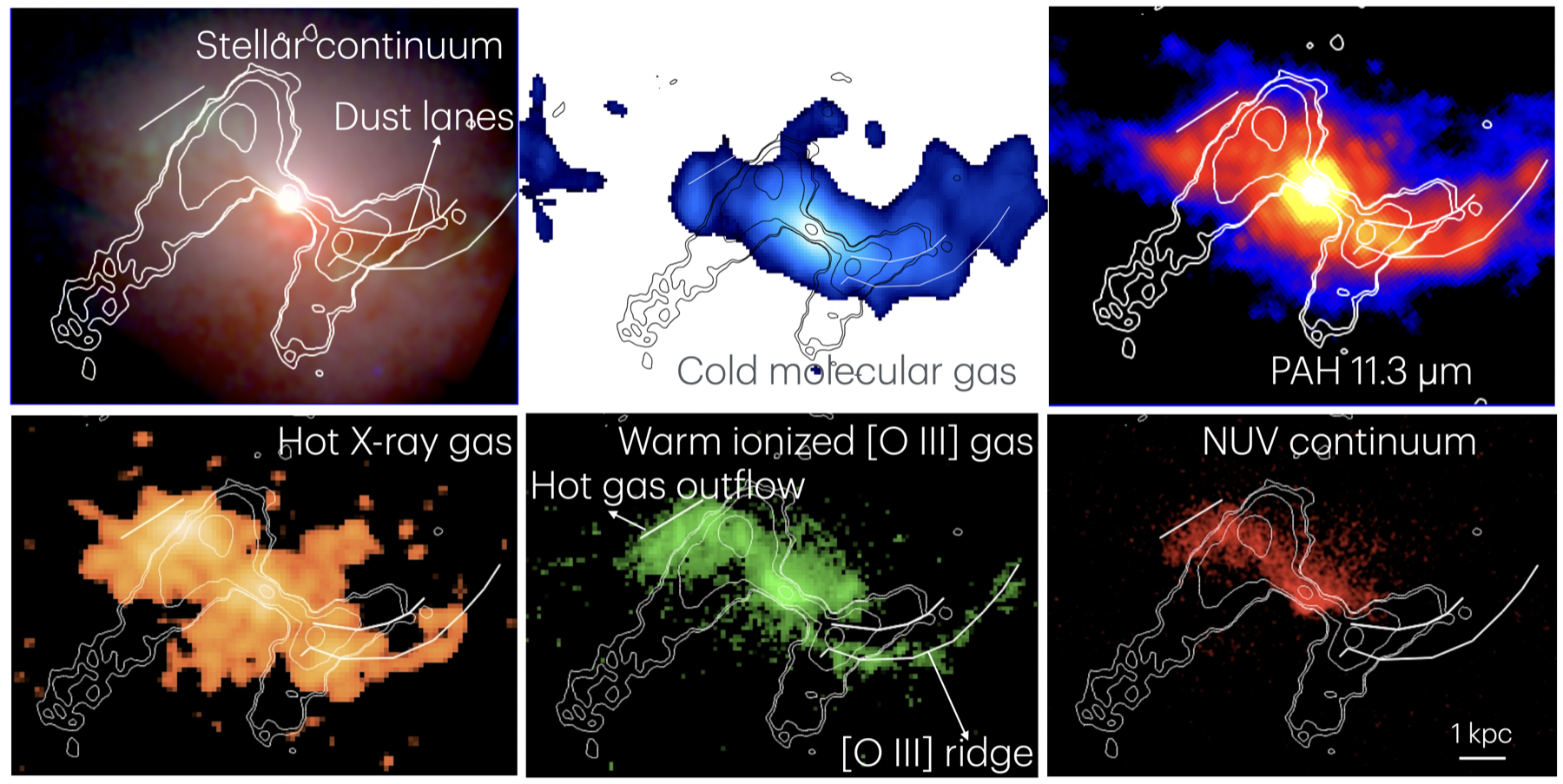
Multiphase gas maps of radio galaxy 3C 305 with radio-jet contours
Multiphase gas in 3C 305, from stellar and dust structure to cold molecular, PAH, X-ray, ionized, and NUV emission. Radio contours trace the compact jet. Sebastian et al. (2026), CC BY 4.0.
First author · 3C 305 · 2026

JWST resolves jet-driven H₂ and ionized outflows

JWST MIRI/MRS, NIRSpec, NIRCam, and MIRI imaging show shocks at both jet-termination hotspots. Warm molecular H₂ outflows reach about 400 km s⁻¹, while ionized gas reaches roughly 1,000 km s⁻¹. Shock diagnostics and the energy budget indicate highly efficient local jet coupling: the jet shock-heats and accelerates dense gas, driving massive kiloparsec-scale multiphase outflows.

Read the 3C 305 paper ↗
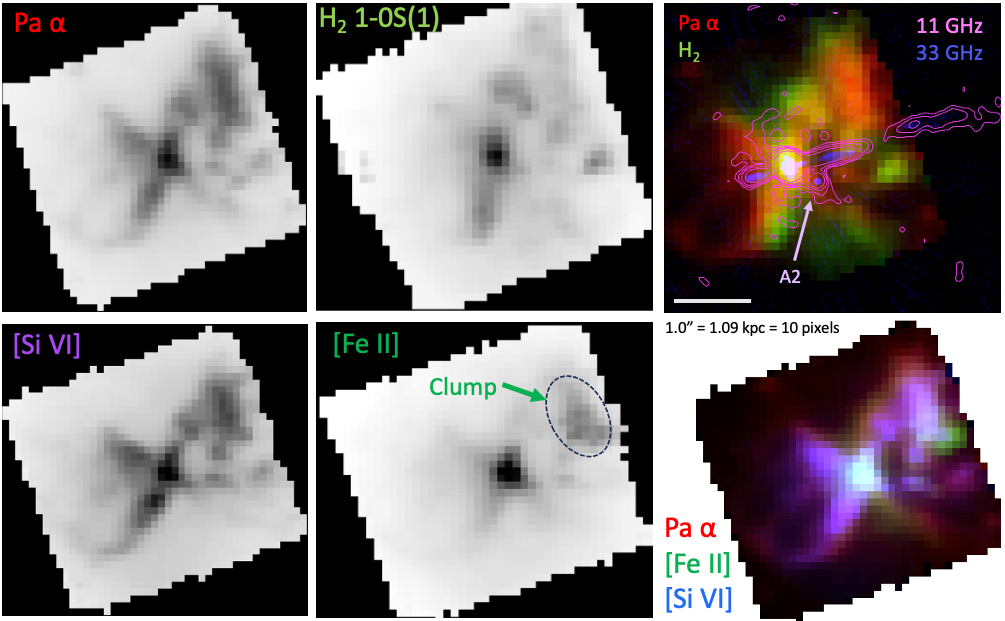
JWST NIRSpec maps of molecular, ionized, and coronal gas in Cygnus A
JWST/NIRSpec maps of Pa α, molecular H₂, [Si VI], and [Fe II] in Cygnus A, with VLA radio contours. Ogle, Sebastian et al. (2025), ApJ, CC BY 4.0.
Second author · Cygnus A · 2025

A jet-driven coronal outflow with a twist

Across 169 infrared emission lines, JWST reveals a density-stratified multiphase bicone shaped by the radio jet. The narrow-line region combines rotation with a roughly 250 km s⁻¹ biconical flow, while compact ionized bullets and streamers reach 600–2,000 km s⁻¹—direct evidence of strong coupling between the jet and dense clouds.

Read the Cygnus A paper ↗
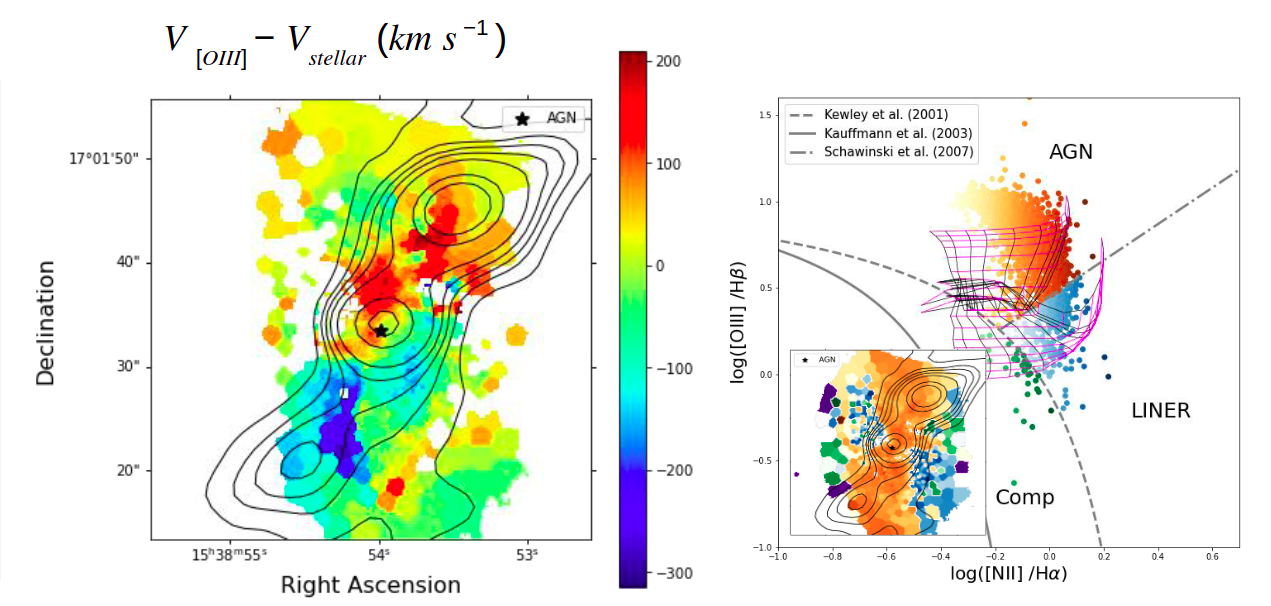
Resolved emission-line diagnostic map of NGC 5972
MUSE · GMRT · VLA

Jet-driven feedback in galaxies

Spatially resolved line diagnostics reveal shocked molecular and ionized gas, outflows, and the energetics of jet–ISM coupling. Our study of the Voorwerp galaxy NGC 5972 combines MUSE spectroscopy with GMRT and VLA imaging to trace jet-driven shocks and feedback.

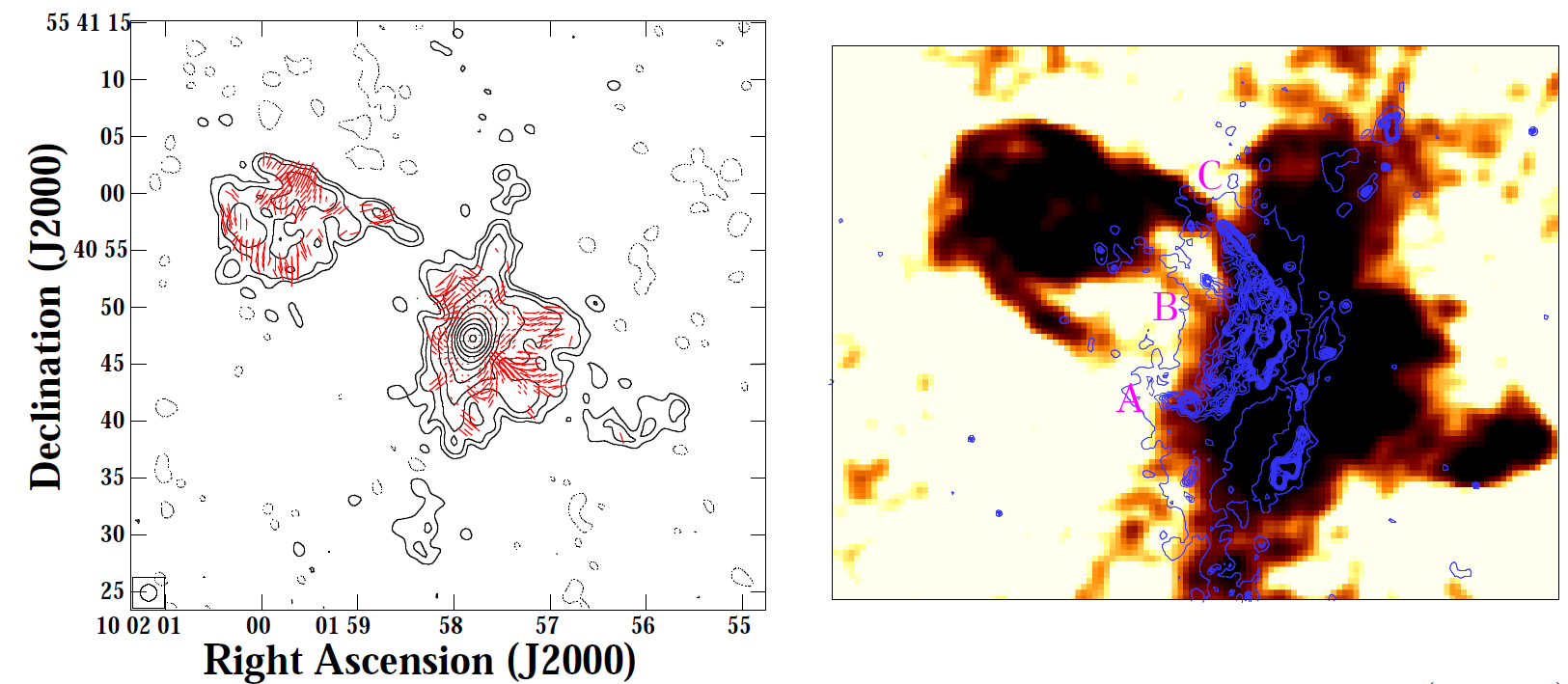
Radio polarization and optical emission in Seyfert galaxy NGC 3079
VLA · Polarimetry · Seyferts

What powers radio-quiet AGN?

Full-polarization VLA observations distinguish AGN jets from star-formation-driven winds. Magnetic fields, radio excess, episodic lobes, and correlations with narrow-line gas point to compact jets as a central source of radio emission and feedback in Seyfert galaxies.

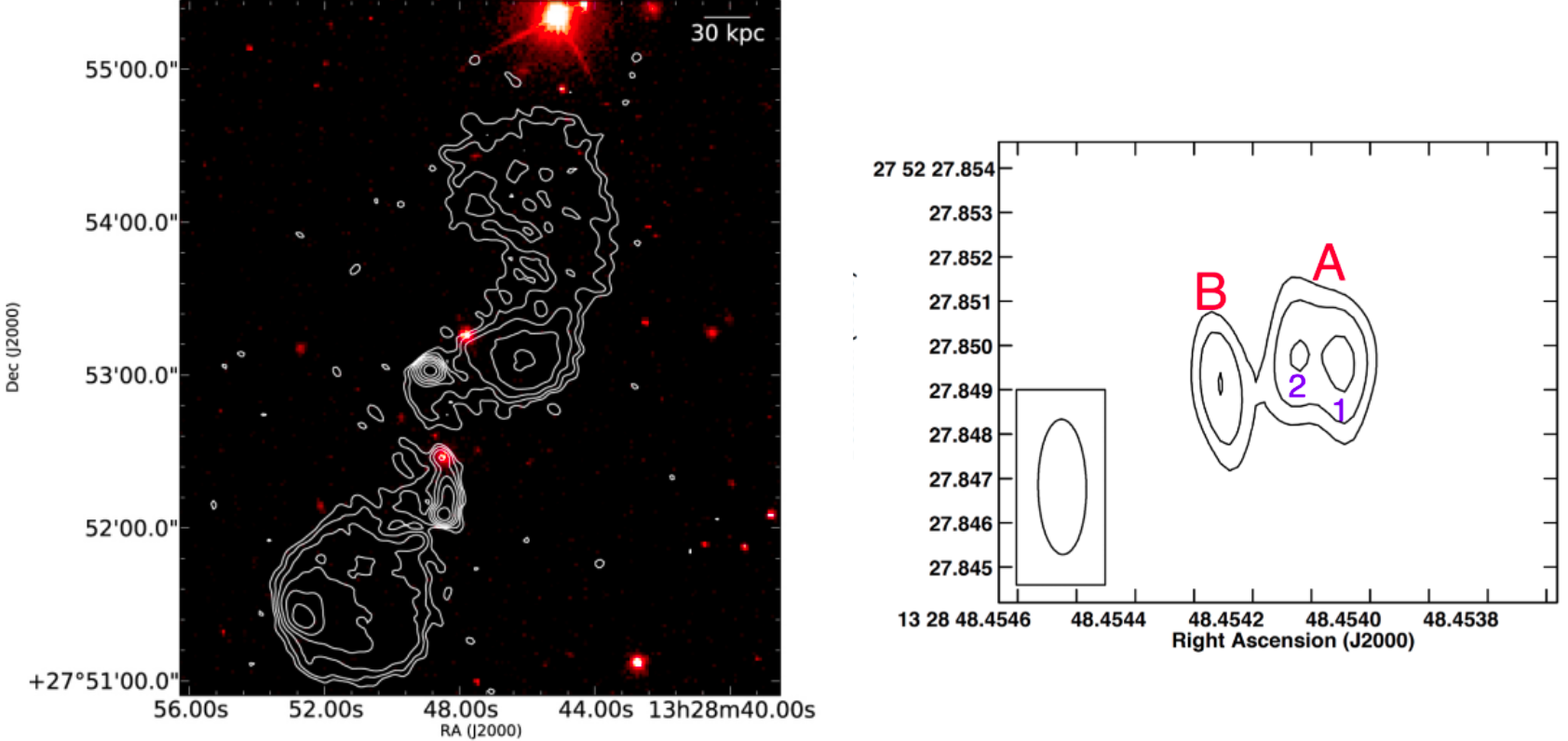
Radio images of binary black hole candidate J1328+2752
VLBA · uGMRT · Dual AGN

Binary supermassive black holes

Very-long-baseline interferometry provides the resolution needed to test indirect binary-black-hole signatures. Our VLBA–uGMRT survey targets galaxies that combine X-shaped radio structure with double-peaked optical lines, identifying compact dual radio components for multi-frequency follow-up.

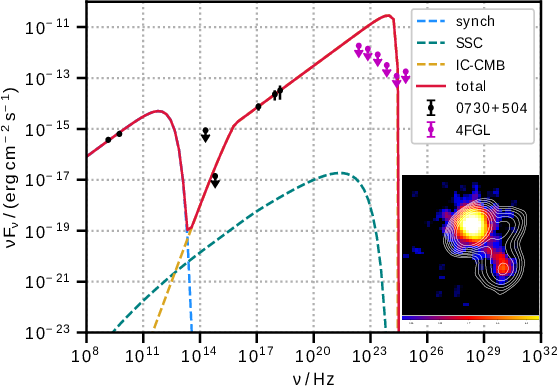
Broadband spectral energy distribution of an X-ray jet
Chandra · HST · VLA

Emission mechanisms of X-ray jets

Broadband spectral-energy distributions of hybrid-morphology blazars test inverse-Compton and synchrotron models for extended X-ray jets. Gamma-ray constraints motivate more physically nuanced models involving multiple synchrotron components and shear-layer acceleration.

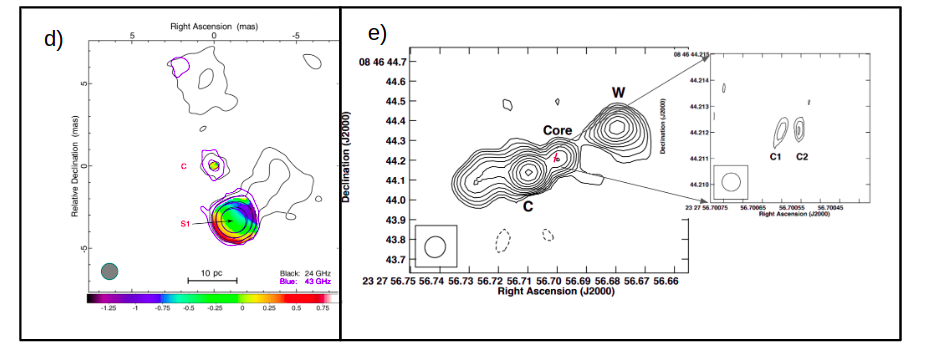
Radio galaxy structure used to investigate black hole activity
uGMRT · VLA · Reionization

Local analogs of early galaxies

Blueberry and Green Pea galaxies are nearby laboratories for the extreme star formation seen during reionization. Their radio spectral energy distributions trace young stellar populations, dense ionized gas, magnetic-field amplification, and conditions that may allow ionizing photons to escape.

Surveys · Data products · Open science

Scalable radio-astronomy analysis

Through CIRADA, I contributed to continuum-processing pipelines and value-added VLASS products. My software work includes polarization-sensitive uGMRT processing, primary-beam correction, survey-image retrieval, and catalog cross-matching.

Explore software →

Facilities and methods: JWST IFU spectroscopy; VLA, VLBA, uGMRT, and ALMA radio interferometry; HST and VLT/MUSE imaging and spectroscopy; Chandra X-ray analysis; polarization, spectral-index mapping, emission-line diagnostics, and broadband SED modeling.